
Hyperspectral imaging is a technology that uses highly detailed spectral analysis of light to visualize differences in physical properties and invisible phenomena that are difficult to discern with the human eye. A hyperspectral camera refers to a camera equipped with a hyperspectral imaging system.
In this section, we’ll cover the basics of spectroscopy, the history of hyperspectral cameras, and the differences between AI and spectroscopy, while also explaining why our spectral technology is the preferred choice.
[Recommended Article] What Is a Hyperspectral Camera?
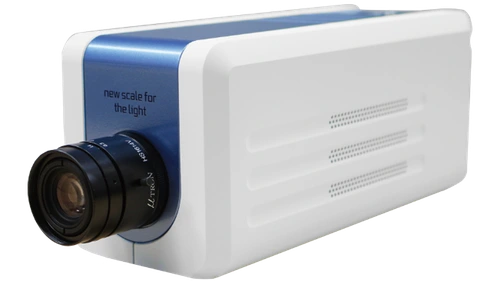
The term "hyperspectral camera" refers to the "built-in scanning hyperspectral imaging system" that our company has been selling since 2007.
Until then, the external stage scanning method was cumbersome and difficult to handle※It all began when a scanning mechanism was built into the camera, enabling it to capture spectral data on its own.
*The vast majority of products currently handled by import trading companies follow this method.





What EBA Spectrum Technology Makes Possible
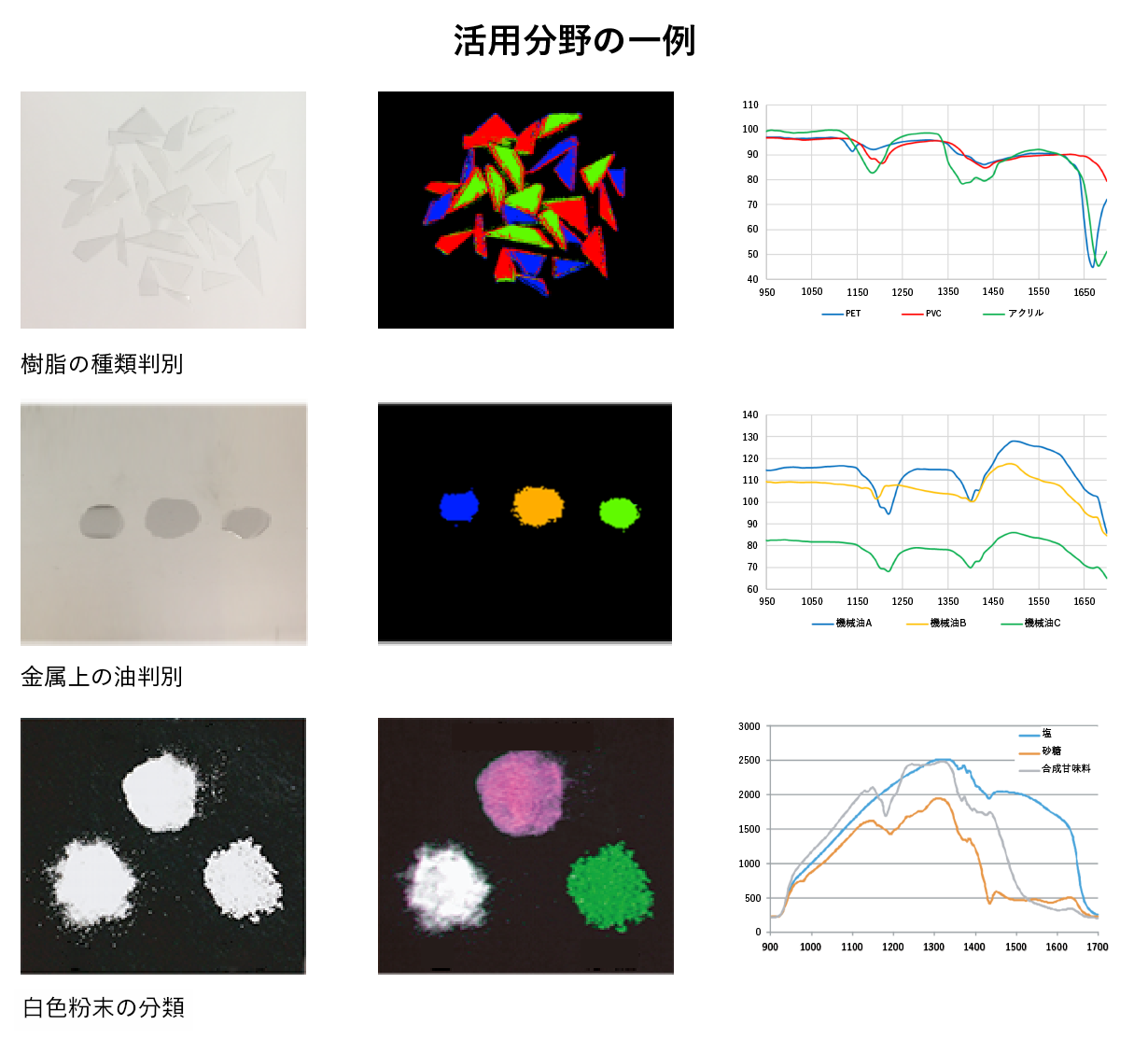
By using spectroscopy, it is possible to evaluate and measure the properties and state of materials in a non-destructive and non-contact manner.
By analyzing the unique spectrum (spectral information) of an object, it is possible to assess the properties and condition of a substance in ways that are difficult to determine with the naked eye.
For example, as shown in the figure on the right, it is possible to distinguish between different types of resins, oils, and powders—differences that are completely imperceptible to the human eye. As a result, this spectral technology is utilized in a wide variety of applications across all fields and industries.
What is a spectrum?
Light is both a wave and a particle. The way an object appears to us changes depending on the wavelength of the light
.
Furthermore, by analyzing this wavelength, we can determine the properties and state of an object.
<Properties of Light>
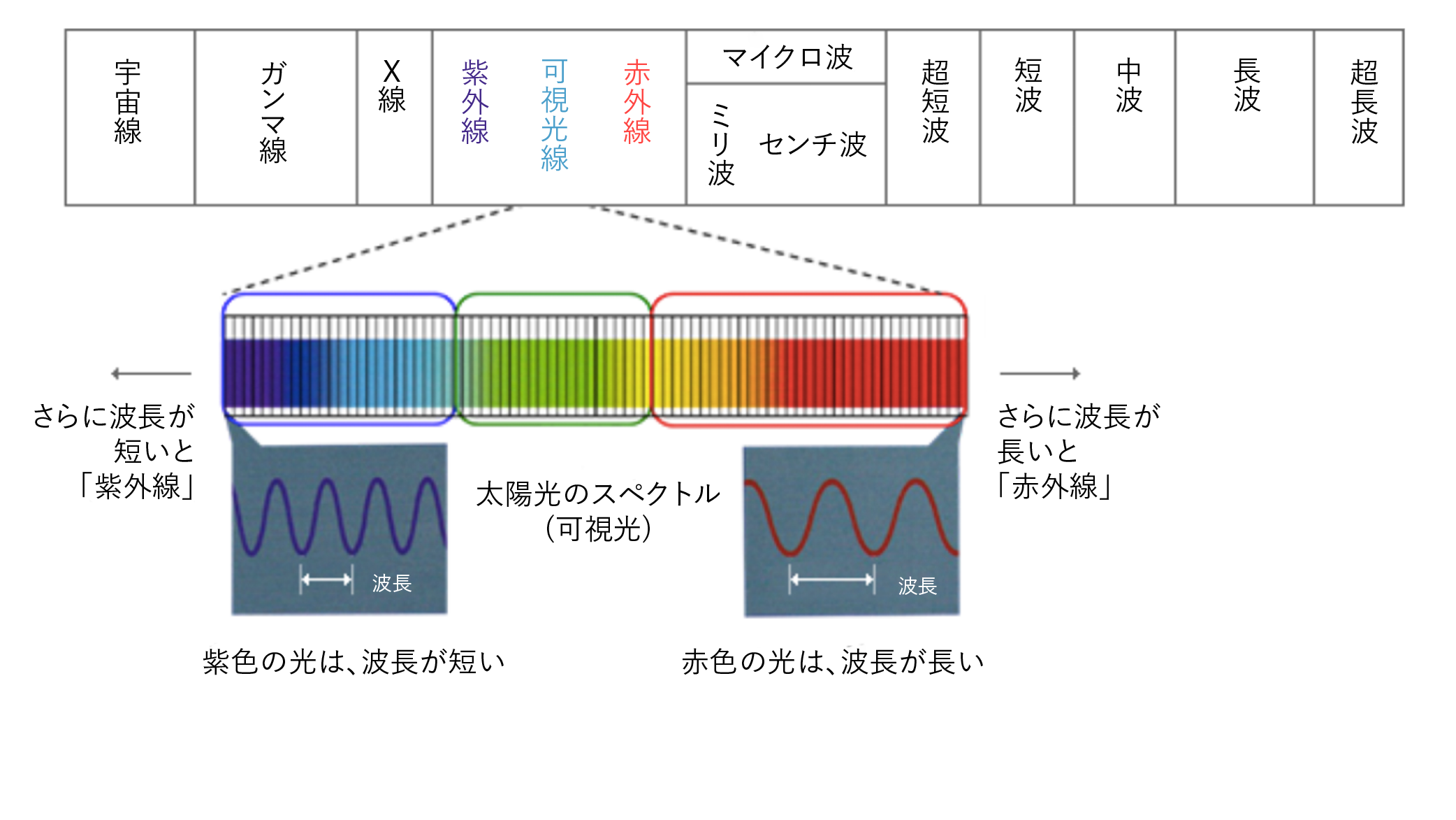
Light is both a wave and a particle. When light is viewed as a wave, the way an object appears to us changes depending on the type of wave. For example, within the visible spectrum, humans perceive light with longer wavelengths as red and light with shorter wavelengths as violet (see figure on the right). By analyzing these wavelengths, we can determine the properties and state of an object.
This difference in wave period is called "wavelength," and it is this difference in wavelength that distinguishes different types of light. Wavelength is measured in "nm" (one-billionth of a meter), and the range of visible light that humans can see falls between approximately 380 nm and 780 nm.
The technique of analyzing this wavelength in detail is called "spectroscopy," and through spectroscopy, we can analyze the characteristics and state of an object in detail. The components of light separated by this process are called a "spectrum," and spectroscopic analysis is also known as spectral analysis.
<How Humans Perceive Light>
The human eye perceives light by using photoreceptor cells called "cone cells," which act as sensors to break visible light into three colors: red, green, and blue (RGB). For example, humans perceive strawberries as red because they absorb light with blue and green wavelengths and reflect light with red wavelengths.
Standard digital cameras and camcorders also capture color data that mimics what the human eye sees by combining these three colors.
What is a hyperspectral camera?
A hyperspectral camera is a type of camera that uses highly detailed spectral analysis of light to determine the material properties and
condition of objects that were previously difficult to evaluate objectively.
Generally, the human eye and color cameras capture light by separating it into three colors: red, green, and blue (RGB). However, by splitting the light into finer wavelengths, it is possible to visualize differences in physical properties that are difficult for the human eye to discern, as well as phenomena that are otherwise invisible.
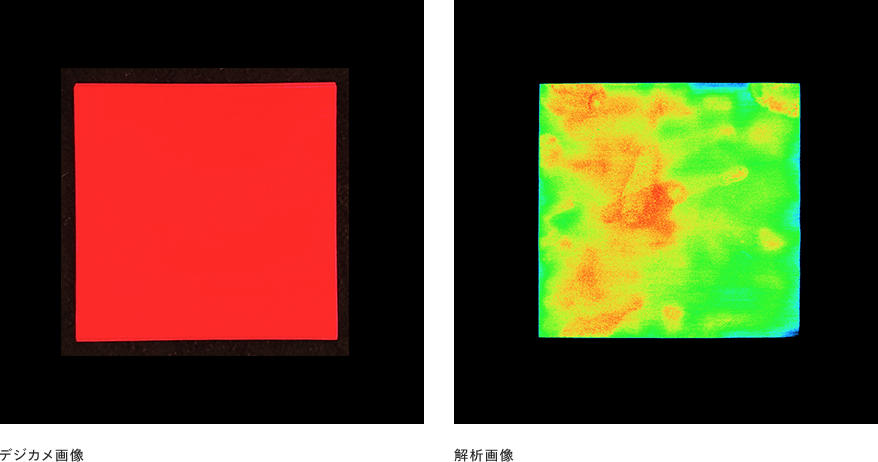
In the case of the red paint on the car shown below, while it appears entirely red in a color image, spectral analysis reveals uneven paint application that is difficult to assess, as shown in the analytical image. This demonstrates how differences in light intensity (spectral distribution) across minute wavelengths—differences that are imperceptible to the human eye—exist between areas of thick and thin paint, and how these differences are being evaluated.
Cameras capable of breaking down wavelengths into fine spectral bands and capturing a continuous series of spectral components (over 100) are called "hyperspectral cameras." The differences between data captured by the human eye or a color camera and data captured by a hyperspectral camera are shown in the figure below.
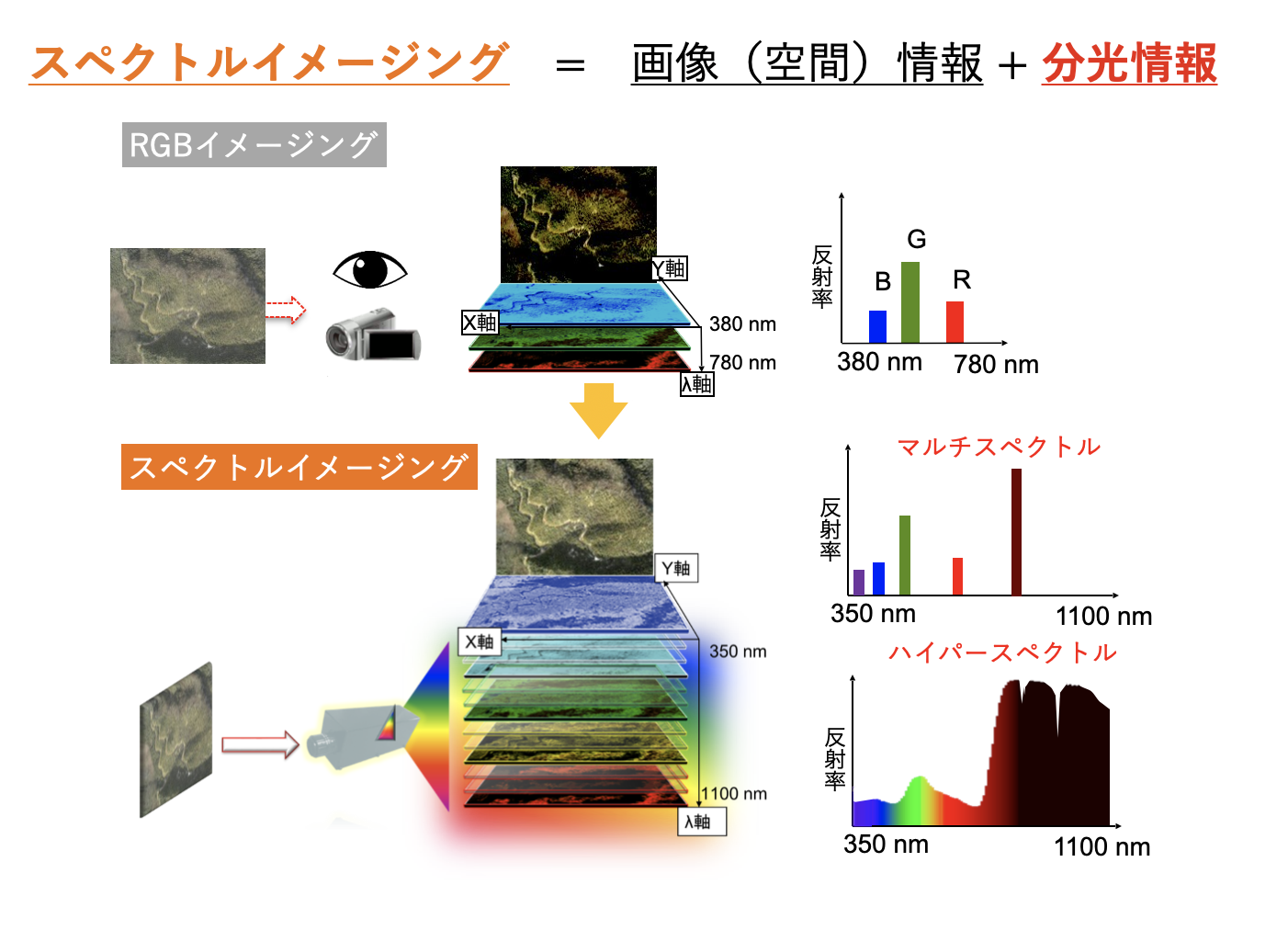
Features of EBA Spectrum Technology
Why We're the Top Choice
01
The No. 1 domestic manufacturer in terms of delivery performance, with an
integrated approach to development, manufacturing, and sales
We are a Japanese manufacturer that conducts in-house research and development on a wide range of spectral imaging technologies, handling everything from patent acquisition to manufacturing, sales, and after-sales support.
Our solutions have been adopted by numerous government agencies and private companies across all industries, and we boast the largest track record of successful implementations in Japan.


02
Development of spectral algorithms
by certified Spectral Analysts®
To meet our customers' needs, advanced spectral data analysis technology is essential. We focus not only on hardware development but also on software development.
Our team of expert spectral analysts specializes in spectral statistical analysis, calibration curve creation, and algorithm development tailored to your specific needs.
03
Proposing spectral solutions
tailored to your specific needs
In addition to selling hyperspectral cameras, we also provide spectral solutions designed to solve the challenges our customers face in the field.
We can provide customized camera and system solutions tailored to your specific needs, including inline spectral inspection systems, aerial photography using drones, and vital sign sensing cameras that capture human biometric data.

State-of-the-art image recognition technology
EBA Spectrum Technology: Beyond AI
<The Difference Between AI and Spectrum>
Conventional AI image processing uses RGB or monochrome input data and primarily extracts spatial features (morphological features). Therefore, improving the accuracy of AI-based image recognition requires a vast amount of labeled data for training.
On the other hand, since a spectrum represents the interaction between light/electromagnetic waves and an object’s energy and captures the object’s unique energy vibrations, spectral images contain not only spatial information but also the subject’s unique energy information.
In other words, while conventional AI image analysis can only capture the statistical morphological features of an object, spectral image analysis can capture the object’s unique characteristics and physical properties (its individuality).
As a result, spectral image analysis enables training-free analysis based on spectral characteristics, as well as high-precision image recognition using only a small number of training data points.
EBA Spectrum Technology is a breakthrough that transcends the limitations of RGB image recognition. It is a human-centered technology of the future that leverages the strengths of AI while shedding light on individuality—without being subsumed by statistics.

MEMO: History of Hyperspectral Cameras

Hyperspectral technology originated in the field of remote sensing, specifically in Earth observation.
Following the invention of the CCD in 1969, technological development progressed in the field of measuring spectral information as images. In the 1980s, A.F. Goetz and colleagues at the California Institute of Technology (Science 1985) first proposed hyperspectral camera technology, which was initially put into practical use on aircraft.
Although it was originally referred to by names such as “Imaging Spectroscopy” [1], since G. J. Brelstaff of the University of Bristol and others began using the term “hyperspectral camera” in the 1990s [2] (Proc. SPIE 1995), this more familiar term has now become the standard.
In the 2000s, the technology began to see practical application in satellite remote sensing, starting with its deployment on the Earth observation satellite EO-1, developed by NASA.
While the equipment installed on aircraft and satellites used to be large-scale and expensive, with limited applications, recent rapid advances in image sensor and computer technology have made it possible to develop compact, portable hyperspectral cameras. By incorporating our proprietary built-in spectral scanning technology, we have successfully developed products that can be utilized by a wide range of customers [3].
This has significantly advanced the development of the hyperspectral market, and we are currently leading the way as a leading company in this field.
[References]
[1] A.F. Goetz, et al. (1985) Imaging Spectrometry for Earth Remote Sensing. Science, 228, 1147–53.
[2] G.J. Brelstaff, et al. (1995) Hyperspectral camera system: acquisition and analysis. Proc. SPIE, 2587, 150‒159.
[3] Y. Takara, et al. (2012) Remote sensing applications with an NH hyperspectral portable video camera. Proc. SPIE, 8527, 85271G.
APPLICATION
Application Fields
EBA Spectral Technology is used in a wide range of fields.







CONTACT
Contact Us
For telephone inquiries
03-6433-1517[Business Hours] Weekdays 10:00-18:00