
The term "hyperspectral camera" refers to the "built-in scanning hyperspectral imaging system" that our company has been selling since 2007.
It all began when we replaced the cumbersome external stage scanning method—which was still used by the majority of importers at the time—by integrating the scanning mechanism into the camera itself, enabling the camera to capture spectral data on its own.
We have been selling hyperspectral cameras since 2007 and have worked with our customers to help grow this market.
Until then, other companies had been marketing their products under names such as “hyperspectral imager” or “imaging spectroscopy.” However, thanks to our efforts, the term “hyperspectral camera” has become widely accepted, and other companies have followed suit. The hyperspectral cameras we promote are devices that can be easily used with both microscopes and telescopes, offering the flexibility to address our customers’ specific challenges.
EBA Japan is a leading domestic manufacturer of hyperspectral cameras.
In recent years, the use of hyperspectral cameras has been expanding across various fields of research and industry. However, due to a mismatch between the specific challenges customers aim to address and the characteristics of individual products, we are seeing an increasing number of inquiries from customers who report that “even after introducing a hyperspectral camera (from another manufacturer), they were unable to resolve their issues.”
I believe this is because you do not fully understand that a hyperspectral camera is merely a tool, not the solution to the problem itself. It is intended solely for R&D purposes, and unless the findings from that research are incorporated into the camera’s design, it cannot be used to solve the problem.
In this article, we will explain key points to help you make the right choice when selecting a hyperspectral camera. This guide is intended for decision-makers at companies and research institutions considering the adoption of hyperspectral cameras. We will cover the purposes of hyperspectral cameras, measurement methods, differences between our domestically manufactured cameras and those made overseas, and real-world case studies.
Table of Contents
- What is a hyperspectral camera?
- Purpose of Hyperspectral Cameras
- Key Considerations When Choosing a Hyperspectral Camera
- ① Types of Hyperspectral Cameras
- ② Confirming Specifications
- ③ Support for Problem Solving
- ④ Other (Adoption records, patents, collaborations with other companies, etc.)
- Points to Note Regarding Overseas Hyperspectral Cameras
- COLUMN: Lessons Learned from Choosing a Hyperspectral Camera
- Why EBA Japan's Hyperspectral Cameras Are the Top Choice
- Summary
What is a hyperspectral camera?
A hyperspectral camera is a camera that captures spectral information for each individual pixel in an image.
By measuring specific wavelengths, this technology captures the chemical properties and states of objects—as well as human perceptions—that cannot be detected by conventional cameras, thereby overcoming the limitations of conventional image inspection.
Purpose of Hyperspectral Cameras
While hyperspectral cameras are certainly used in R&D, as we’ve listened to our customers’ various challenges, we’ve come to realize that they are not merely a technology for R&D, but one that customers also rely on to solve real-world problems on the ground.
To meet those expectations, we have been conducting our own research and development for over 15 years, offering spectral solutions designed to address on-site challenges—such as our “Target Spectrum Camera,” a specialized camera equipped with algorithms tailored to each of our customers’ specific needs.
We believe that the "goal" is, above all, a solution that addresses on-site challenges, and that the "hyperspectral camera" is a means to achieve that goal.
So, what exactly should you look for when choosing a hyperspectral camera for on-site use? We’ll cover the key points starting in the next section.
Key Considerations When Choosing a Hyperspectral Camera
① Types of Hyperspectral Cameras
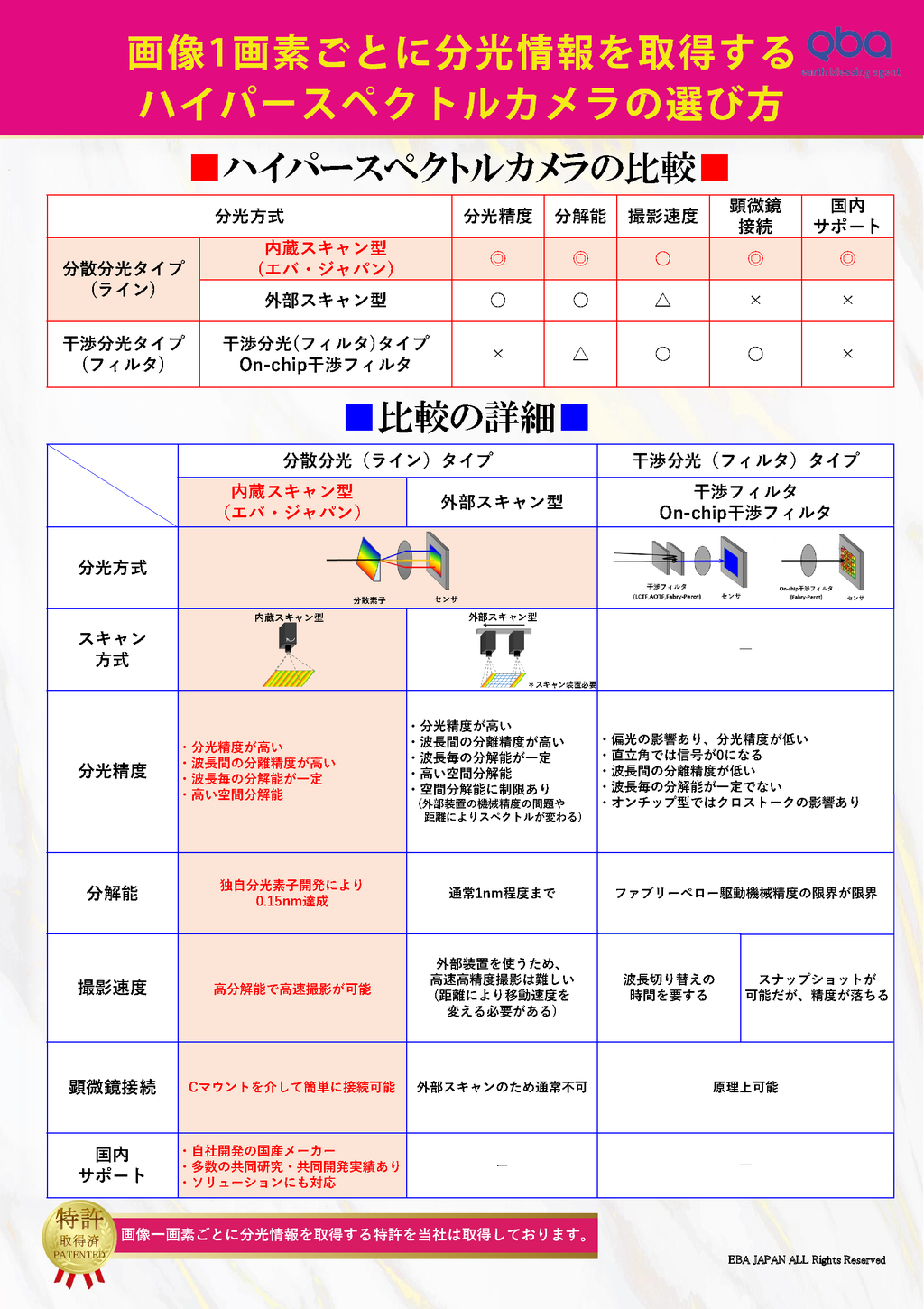
Hyperspectral cameras can be broadly classified by their spectral separation method into two types: wavelength-dispersive types, which use diffraction gratings or prisms, and interference filter types, which are based on interference technologies such as Fabry-Perot.
Features of the wavelength-dispersive type
Although wavelength-dispersive systems offer the highest level of spectral accuracy, because they are line-scanning systems, they require spatial scanning to acquire two-dimensional images. Since many cameras of this type require an external scanning mechanism, they result in large, bulky systems and are therefore unsuitable for measurements outside of inline applications.
Features of Interference Filter Types
While interference filter-type cameras do not require external devices and on-chip cameras offer the advantage of high-speed imaging across all wavelengths in a single frame, the wavelength resolution is not consistent across wavelengths, leading to reduced separation accuracy between wavelengths. LCTF (liquid crystal tunable filter),AOTF (acoustic tunable filter) are affected by polarization, and on-chip types suffer from crosstalk between wavelengths (pixels) and the inability to acquire spectral images of the same point in space; consequently, their spectral accuracy is less reliable.
Given that the purpose of acquiring hyperspectral data is to develop algorithms for establishing solutions, these shortcomings become problematic because the acquisition of high-precision spectral images is essential.
Features of Our Hyperspectral Camera
As shown in the figure below, our hyperspectral camera not only features world-class spectral accuracy in the wavelength-dispersive type but also eliminates the need for external mechanisms thanks to its built-in scanning mechanism. Since the camera can capture spectral images on its own, it can be easily applied to both inline and offline applications and offers numerous advantages, such as being portable and capable of connecting to other equipment, such as microscopes.
② Confirming Specifications
Another factor making it difficult to select a camera is that the specifications provided by different manufacturers are not standardized. Therefore, we have listed some points to keep in mind when reviewing specifications.
Wavelength resolution:
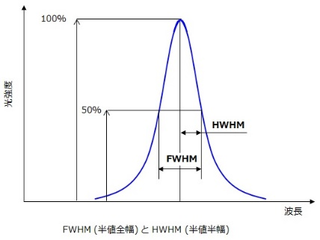
It is important to note that the "wavelength resolution" values provided by various companies may refer to either the "half-width" or the "sampling interval."
The half-width is also known as FWHM (Full Width at Half Maximum), which refers to the wavelength range over which the intensity of the dispersed light falls to half its peak value; this value represents the intrinsic wavelength resolution required to distinguish between two adjacent wavelengths (see figure on the right).
On the other hand, the sampling interval refers to the interval at which the sensor acquires spectral information; while it is smaller than the half-width, this value is sometimes referred to as the wavelength resolution, so it is important to verify this.
Number of wavelengths (cf. number of wavelength channels, number of bands, number of wavelength data points, wavelength resolution):
There are various notation conventions, but they all represent the number of spectral wavelengths output. Since this value varies depending on whether it is expressed in terms of half-width or sampling interval, it is important to verify it.
Please note that higher wavelength resolution results in darker images as the number of wavelengths increases, which in turn leads to longer exposure times. Therefore, it is not necessarily the case that higher wavelength resolution is always better; we recommend selecting a resolution that best suits your specific purpose.
We offer custom manufacturing to meet our customers' specific requirements, ranging from 0.1 nm to several tens of nanometers.
Image resolution (see also: spatial resolution, number of spatial channels, number of pixels):
Generally, this refers to the number of pixels captured in a single exposure, though there are various ways of expressing this. In the case of external-scan hyperspectral cameras, since the camera itself captures information from only a single line, a one-dimensional value (a single number; typically, a two-dimensional value representing both vertical and horizontal dimensions) is listed.
Please note that if you continue shooting a single line, the image size can easily reach several million pixels (in which case the image data will resemble a long, narrow strip). A higher image resolution does not necessarily mean the image is better in every respect.
Spectroscopic method:
As mentioned in ➀, accuracy and environmental adaptability vary depending on the spectroscopic method, so it is necessary to verify that the method is suitable for your specific purpose.
For example, distortion often occurs, and when connected to a microscope, some models can only capture about half of the image properly.
Please note that if you choose something that doesn't suit your needs, it may end up being a complete waste.
Dimensions and Weight:
Generally, since the specifications listed are for the camera alone, it is necessary to also check the actual size and weight of the entire system.
These are a few points to keep in mind when reviewing the specifications. However, since it is usually impossible to determine whether a camera is suitable for your intended use based solely on the published specifications, we strongly recommend that you evaluate the actual unit through a demo or similar means. If you have any concerns, please feel free to contact us.
③ Support for Problem Solving
Whether a manufacturer possesses the technological solutions needed to address specific challenges is a key consideration when selecting a hyperspectral camera.
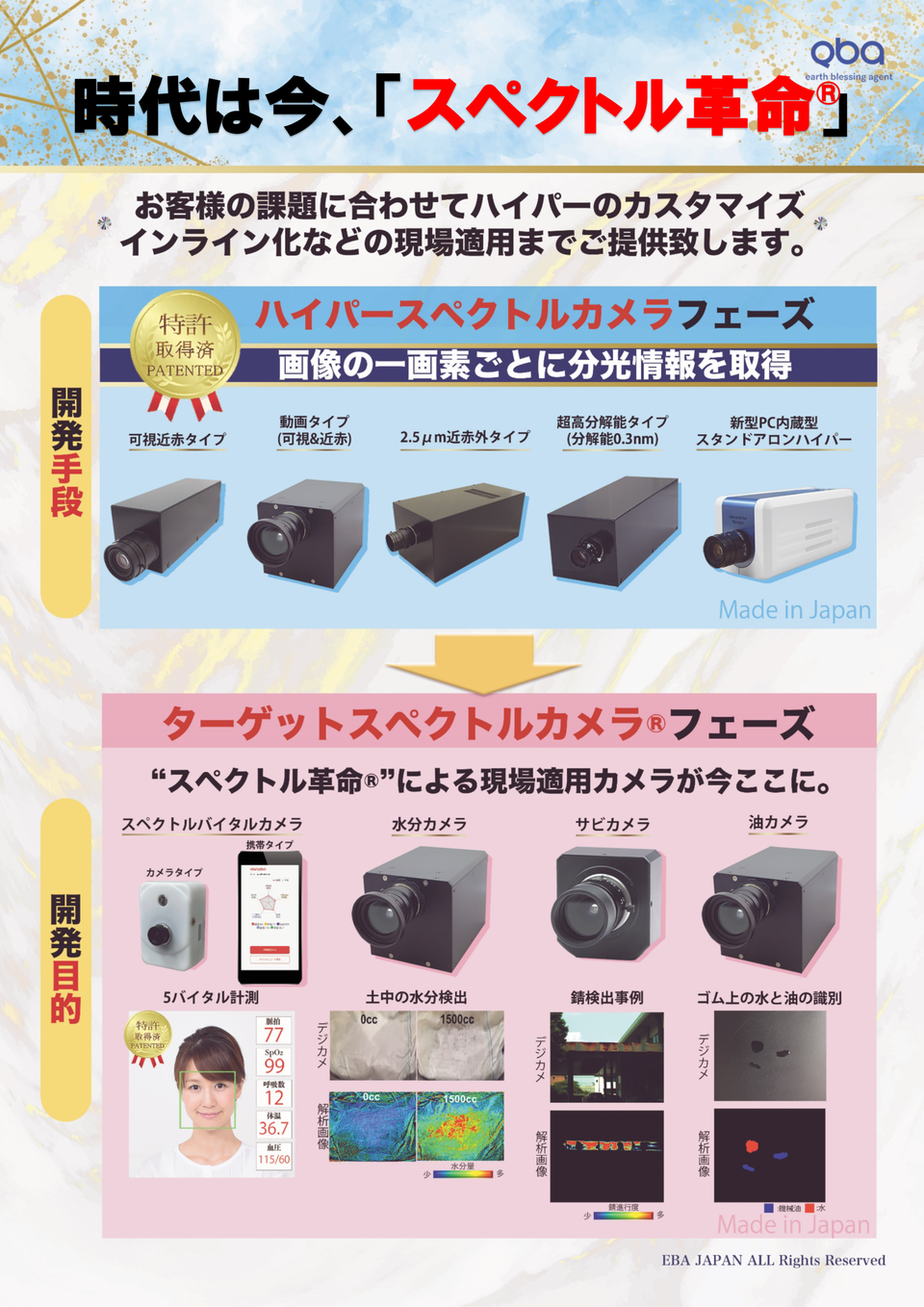
We handle the entire process—from development to manufacturing—for both hardware and software. After conducting an analysis using hyperspectral cameras, we can freely design and manufacture custom cameras tailored to your specific measurement needs, including both hardware and software. Furthermore, because we manufacture our products in-house, we are able to provide prompt support and warranty service.
(Reference: EBA Japan Solution Workflow)
④ Other (Adoption records, patents, collaborations with other companies, etc.)
We have a proven track record of successful placements in government agencies, educational institutions, and corporations
Because hyperspectral cameras are a relatively new technology that has gained traction in recent years, as mentioned earlier, there is some variation in the specifications provided by different manufacturers, making it difficult to establish clear criteria for comparison. However, the most reliable approach is to focus on their track record of successful implementation.
We are a Japanese manufacturer that conducts in-house research and development on a wide range of spectral imaging technologies, handling everything from patent acquisition to manufacturing, sales, and after-sales support.
Our solutions have been adopted by numerous government agencies, educational institutions, and corporations across all sectors, and we boast the largest track record of successful implementations in Japan.
[Reference: Selected Project Portfolio]
| Panasonic | NEC | Fujitsu Laboratories |
| Toshiba | Fujitsu General | Sharp |
| Hitachi, Ltd. | Sony | Seiko Epson |
| Citizen Electronics | Pioneer | Omron |
| Yaskawa Electric | Yokogawa Electric | Kyocera |
| SCREEN Holdings | Nikon | Olympus |
| Canon | Fujifilm | Pentax |
| Konica Minolta | Mitsubishi Heavy Industries | Mitsubishi Heavy Industries Transportation Systems Engineering |
Has been cited in academic papers
Our products have been cited extensively in academic papers (see table below).
| Field | Number of papers |
|---|---|
| Food and Agriculture | 38 |
| Beauty and Medical | 46 |
| Industry | 81 |
| Construction and Infrastructure | 20 |
| Remote Sensing | 23 |
| Other | 10 |
| Total | 218 |
[Reference: Papers and Research Case Studies]
Patent
Since we hold a patent for acquiring spectral information for each individual pixel in an image, our customers can use our products with confidence, knowing they do not infringe on any other patents.
[Reference: Intellectual Property & Patents]
Collaborations with Other Companies
Our technology has earned the trust of many customers and has led to various collaborative projects.For example, we are engaged in collaborations with a wide range of organizations, including the exhibition of our hyperspectral camera at the National Museum of Emerging Science and Innovation (Miraikan), the installation of our vital signs camera in medical vehicles by Toyota Auto Body, the permanent exhibition of our smartphone app “Vitarhythm” at NTT East’s NTTe-city Labo, and joint research and development of smart toilets with the National Cancer Center. Our technology is now on the verge of being implemented in society.
Related links:
[Exhibition at the National Museum of Emerging Science and Innovation]
[Installation of Vital Sign Cameras in Medical Vehicles]
[NTTe-city Labo: Permanent Exhibition of the "Vitarhythm" Smartphone Vital Signs Measurement App]
Points to Note Regarding Overseas Hyperspectral Cameras

Currently, with the exception of our products, the majority of hyperspectral cameras sold in Japan are manufactured overseas. Most distributors in Japan are import trading companies, and it is safe to say that virtually none of them have the systems in place to provide spectral consulting services. Therefore, please be aware that you may find yourself unsure of how to use the camera for your specific purposes after purchase.
While some foreign-made hyperspectral cameras are easy to use with a snapshot mode, many of them have poor spectral accuracy and are unsuitable for their intended purpose of research and development, so caution is advised.
In addition, while some products utilize wavelength-division multiplexing, as mentioned above, most of them require external equipment, resulting in bulky devices that are difficult to handle.
Furthermore, because the software is foreign-made, it is written in a foreign language, which can make it difficult to understand how to use it. Even if there are issues or suggestions for improvements, it is difficult for overseas vendors to respond flexibly.
Please note that delivery dates and prices are subject to change due to international conditions and exchange rate fluctuations.
As a domestic manufacturer, we offer flexible solutions, including customization of hardware and software. We also provide comprehensive after-sales service following camera installation, supporting our customers until they are fully operational.
COLUMN: Lessons Learned from Choosing a Hyperspectral Camera
Here, we share some feedback from customers who came to us for advice after failing to achieve the desired results with hyperspectral cameras purchased from other companies.
Major Company A
We installed an imported external line-scan camera, but when setting up the shot, it could only capture one line at a time, so it was hard to tell where the focus was and difficult to adjust it...
Lighting Manufacturer Company B
We were using a hyperspectral camera capable of capturing visible-spectrum spectral data in two dimensions for medical experiments, but because the field of view was narrow, we had to shoot from a considerable distance away from the subject, which made the measurements much more difficult than we had anticipated...
Associate Professor at University C
We were exploring the use of hyperspectral cameras for our image processing research. After conducting some research, we found a company that offered rental services and placed an order. However, they simply sent us the equipment without any instructions on how to use it, so it took us a long time to figure out how to operate it, and we were unable to conduct the evaluation we had hoped for...
Professor at E University
During animal experiments in medical information engineering, we used an imported interference-filter-type hyperspectral camera, but this resulted in time differences in imaging between wavelengths. Additionally, due to polarization characteristics, certain wavelengths became impossible to evaluate, and we were unable to obtain sufficient data for the students’ presentations...
Construction Consulting Firm F
We tested a foreign-made external line-scan spectrometer to evaluate soil properties, but since it failed to detect any near-infrared absorption peaks for the target substance, we questioned its reliability in providing data that could serve as scientific evidence and decided not to use it...
Professor at G University
In order to closely examine the fluorescence wavelengths of fluorescent substances, I tested a foreign-made on-chip interference filter-type hyperspectral camera, but I was unable to successfully acquire the data because the resolution was too low and there was a shift in the imaging position for each wavelength...
Associate Professor at H University
I contacted a company that advertised on its website that it offered road environment lighting simulations starting at 2 million yen, but their responses to my inquiries were extremely slow, and they were completely unable to answer my technical questions. Their attitude made me feel uneasy—it seemed as if they were just a bunch of amateurs acting like college students…
Major Company I
To explore the potential use of hyperspectral cameras—which are commonly seen at trade shows—I conducted some online research and then received a demonstration and presentation from a distributor that handles overseas products. However, since I lacked knowledge about the products, I couldn’t get a clear answer on how they could address our company’s challenges, and I was left feeling confused when they simply tried to push me to buy a camera…
Major Company J
With an eye toward future use on inspection lines, we introduced a hyperspectral camera manufactured overseas. However, we were unable to evaluate the targets we had originally planned to test. When we contacted the supplier, we didn’t receive any meaningful support for the process from basic verification to integration into the inspection line, which left us in a bind…
Company D, a housing services company
I used a small, portable hyperspectral camera made overseas to measure a building outdoors, but its sensitivity was too low for outdoor use, so I was unable to acquire the spectral data needed for the evaluation...
Why EBA Japan's Hyperspectral Cameras Are the Top Choice
Our hyperspectral cameras boast the largest installation base in Japan. Finally, we’ll summarize the reasons why our hyperspectral cameras are the top choice.
① World-class spectral technology
Our hyperspectral camera is a "wavelength-dispersive" model capable of capturing the most accurate spectral data. Because we have consistently prioritized our customers' needs in our in-house development, our camera offers world-class spectral accuracy and ease of use.
② The ability to provide solutions that support customers every step of the way until their challenges are resolved
As a hyperspectral company, we have been providing in-house developed solutions based on the expertise we have accumulated over more than 15 years of working with our customers to solve their challenges. As a result, we maintain a long-term relationship with our customers even after delivery. We go beyond simply providing hyperspectral cameras; we constantly work with our customers to identify and address their underlying objectives, and we continue to offer proposals that align with their best interests.
③ Extensive track record and patents
As you can see from our track record of successful deliveries, we are Japan’s leading manufacturer of hyperspectral cameras. We have earned a high level of trust thanks to the numerous success stories from our customers—including those published in academic journals—that demonstrate the effectiveness of our products. Furthermore, as we hold international patents for our spectral technology, you can use our products with confidence even overseas.
Summary
That concludes our guide on "How to Choose a Hyperspectral Camera Without Making a Mistake."
We sincerely hope this article will assist you in making your decision and prove useful for your research and problem-solving efforts.
As a leading company in this field, we are committed to continuing to serve the market. If you have any concerns—even if they involve other companies—please do not hesitate to contact us.
If you have any questions about this article or our services, please feel free to contact us by phone or through the contact form.
APPLICATION
Application Fields
EBA Spectral Technology is used in a wide range of fields.







CONTACT
Contact Us
For telephone inquiries
03-6433-1517[Business Hours] Weekdays 10:00-18:00